Templates & Guides

Feb 22, 2026
Veterinary SOAP Notes: Complete Guide with Templates
Share to :


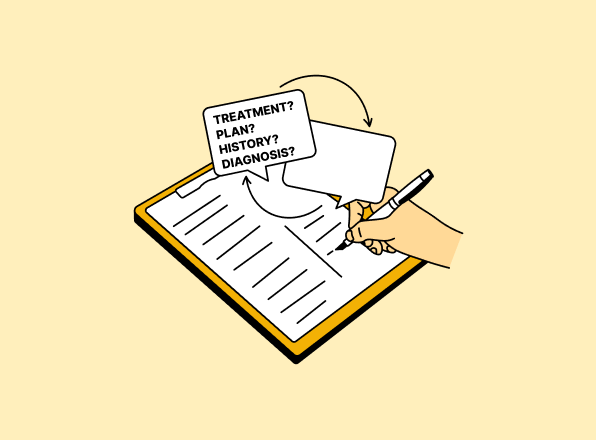
Every vet learns the SOAP format at uni. Subjective, Objective, Assessment, Plan — it's the backbone of clinical documentation. But in practice, SOAP notes are one of the biggest time drains in a vet's day.
At 20 consults a day and ~10 minutes per note, you're looking at over 3 hours of admin. And that's if you actually get them done — many vets admit notes fall to the bottom of the priority list when it gets busy.
This guide covers how the SOAP format works in veterinary practice, gives you filled templates you can adapt, walks through the most common mistakes, and shows how modern AI tools can generate SOAP notes for you automatically.
SOAP notes are a structured clinical documentation format used across medicine — including veterinary medicine. The acronym stands for:
The format separates what the owner reports from what you find on examination, followed by your clinical judgement and treatment plan. This structure makes notes consistent, scannable, and legally defensible.
Most practice management systems expect some variation of SOAP, and it's the standard taught in veterinary schools across Australia and internationally.
The subjective section captures everything reported by the owner — the reason for the visit, symptoms they've noticed, onset, progression, and relevant history.
What to include:
Example:
Owner presents 6-year-old MN Labrador "Max" for lethargy and reduced appetite over the past 3 days. Normally very active but has been reluctant to go for walks. Eating about half his normal meals. Drinking normally. No vomiting or diarrhoea. Up to date with vaccinations and parasite prevention (NexGard Spectra monthly). No previous significant medical history. Currently on no medications.
The key rule: only include information the owner has actually told you. Don't infer or assume.
The objective section is your clinical findings — everything you can measure, observe, and document during the examination.
What to include:
Example:
Demeanour: QAR Vital Signs: - Heart Rate: 100 bpm - Respiratory Rate: 24 breaths/min - Temperature: 39.8°C - BCS: 6/9 - Hydration: Mildly dehydrated (~5%)
Examination Findings: - Cardiovascular: Grade II/VI systolic murmur, left apex. Regular rhythm. - Respiratory: Clear on auscultation bilaterally - Abdomen: Mild discomfort on cranial abdominal palpation. No organomegaly. - Peripheral lymph nodes: Normal on palpation - Musculoskeletal: Ambulatory, no lameness - Integument: No lesions, no ectoparasites - Oral: Grade 2/4 dental disease, mild gingivitis
Diagnostics: - PCV/TS: 48% / 72 g/L - In-house biochemistry: ALT mildly elevated (95 U/L, ref 10-80)
For any system you didn't examine, leave it blank or note "not examined" — don't fill in normal findings you didn't actually check.
The assessment pulls together your subjective and objective findings into a clinical picture. This is where your expertise and clinical reasoning live.
What to include:
Example:
Problem List: 1. Lethargy and inappetence — 3-day duration 2. Pyrexia (39.8°C) 3. Cranial abdominal discomfort 4. Mildly elevated ALT 5. Grade II/VI systolic murmur — incidental finding, to monitor
Presentation consistent with an acute systemic illness with possible hepatobiliary involvement given elevated ALT and cranial abdominal pain. Differentials include infectious disease, pancreatitis, hepatopathy, or GI foreign body. Pyrexia supports an inflammatory or infectious process.
Keep it evidence-based. Stick to what the findings actually support — don't speculate beyond what the data shows.
The plan covers your treatment decisions, diagnostics, follow-up, and what you've communicated to the client.
What to include:
Example:
Treatment: - Amoxicillin-clavulanate 12.5 mg/kg PO BID x 7 days - Maropitant 2 mg/kg PO SID x 3 days - Bland diet (boiled chicken and rice) for 3-5 days, then gradual transition back to normal food
Diagnostics recommended: - Abdominal ultrasound to assess hepatobiliary system - Spec cPL to rule out pancreatitis
Client communication: Discussed likely infectious or inflammatory process. Owner elected to trial empirical treatment and monitor for 48 hours before pursuing further diagnostics. Discussed signs to watch for (worsening lethargy, vomiting, not eating at all) and advised to present to emergency if deterioration. Owner declined abdominal ultrasound at this stage but open to reconsidering if no improvement.
Recheck: 48 hours, or sooner if deterioration.
Document what the owner declined as well as what they agreed to — it protects you clinically and legally.
Here's a complete veterinary SOAP note template you can adapt for your practice. This is based on an unwell consultation:
History: [Summarise all history reported by the owner — symptoms, onset, progression, previous conditions, medications, diet, water intake, toileting behaviour, and any owner concerns. Concise narrative format.]
Vital Signs: - Heart Rate: [bpm] - Respiratory Rate: [breaths/min] - Temperature: [°C]
Demeanour: [BAR / QAR / Dull / Obtunded]
Examination Findings: - Eyes: [findings or leave blank if not examined] - Ears: [findings or leave blank if not examined] - Oral: [findings or leave blank if not examined] - Cardiovascular: [findings or leave blank if not examined] - Respiratory: [findings or leave blank if not examined] - Abdomen: [findings or leave blank if not examined] - Musculoskeletal: [findings or leave blank if not examined] - Integument: [findings or leave blank if not examined] - Peripheral lymph nodes: [findings or leave blank if not examined] - Urinary/Genital: [findings or leave blank if not examined] - BCS: [/9] - Hydration: [status]
Problem List: [Prioritised list of problems identified from history and examination.]
[Narrative synthesis integrating subjective and objective findings. Clinical interpretation and differentials.]
Treatment: [Medications, procedures, dietary recommendations — with doses and frequencies.]
Client Communications: [What was discussed with the owner, including declined treatments and prognosis.]
Recheck: [Follow-up schedule.]
This template is based on the SOAP format used by practices running Whippet Notes — where the note gets generated automatically from the consultation recording.
The most common mistake: putting your examination findings in the subjective section, or owner-reported symptoms in the objective. Keep them separate. The subjective is what the owner told you. The objective is what you found.
Writing "NAD" for a system you didn't actually examine is risky. If you didn't check the eyes, don't write "Eyes: NAD." Leave it blank or write "not examined." If there's ever a complaint, you need your notes to reflect what you actually did.
"Started antibiotics" isn't enough. Record the drug, dose (mg/kg), route, frequency, and duration. Incomplete medication records create problems when another vet sees the patient, or if there's an adverse reaction.
What you discussed with the owner — especially what they declined — is critical documentation. If you recommended an ultrasound and they said no, write that down. This protects you and gives the next vet context.
The longer you wait, the less accurate your notes become. Details get muddled between patients. If you're writing up 8 consults at the end of the day, you're working from memory — and memory isn't reliable after 20 patients.
This is the mistake that AI veterinary scribes solve directly. The consult is recorded as it happens, so nothing gets lost.
Be consistent. Pick a template and stick with it across your practice. Consistency makes notes faster to write and easier for colleagues to read. Whether you use a detailed system-by-system format or a more narrative style, the structure should be the same every time.
Use your template's defaults wisely. A good template pre-fills normal findings where appropriate (e.g. "Clear on auscultation" for respiratory) so you only need to edit what's abnormal. This saves time without sacrificing thoroughness.
Write notes during or immediately after the consult. The closer to real-time, the more accurate your notes. Even quick dot points during the consult that you flesh out immediately after are better than writing from memory at 7pm.
Include enough detail for the next vet. Your notes should make sense to a colleague who sees the patient next week — or in two years. That means medication doses, not just drug names. Specific findings, not just "normal."
Don't over-document. More words don't mean better notes. A concise, well-structured SOAP note is more useful than three paragraphs of narrative. Focus on clinically relevant information.
The biggest shift in veterinary clinical documentation is AI scribes — tools that record the consultation and generate the SOAP note for you.
Here's how it works with Whippet Notes:
The note only includes information from the actual consultation. No hallucinated findings, no assumed history. If something wasn't discussed or examined, the field stays empty.
"Note taking has always been one of my lowest priorities... And now, they actually get done." — Dr Will Gartrell, Frankston Heights Veterinary Centre
The result: instead of spending 10 minutes typing after each consult, vets review a pre-written note in under a minute. Across a full day of consults, that's hours of admin time saved — time that goes back to patients, clients, and life outside work.
"Whippet Notes allows me to focus on my patient and client, knowing the details of our conversation are locked away." — Dr Alana Dowdell, Pets And Their People
Every practice documents differently. Whippet Notes lets you customise your SOAP template — add or remove sections, change the level of detail in each system, set default values for normal findings, and adjust the extraction instructions for each field.
Whether you prefer a detailed system-by-system examination format or a more streamlined approach, the AI generates notes in your format, not a generic one. You can see examples of different template styles on the features page.
If you're spending hours on SOAP notes every day, there's a better way. Try Whippet Notes free — 10 free consults per month, no credit card required. Set up your SOAP template and see what your notes look like when an AI writes them for you.
Most vets are up and running in under 5 minutes.

Connected